_edited.png)


Strengthen This First—Before Your Medical Device Commercialization Slows Down

Updated: Mar 30
The pillar most teams underestimate… and pay for later
Most medical device companies don’t fail because of poor technology.
They struggle because commercialization doesn’t scale the way they expected.
And when that happens, the instinct is usually to ask the following:
What should we fix?
More sales effort? Better marketing? More distributors?
But in reality, the answer is usually much simpler—and more foundational.
There is one pillar that, if not strengthened early, quietly weakens everything else.
The First Pillar to Strengthen:
Realistic Commercial Sales Strategy
Before building teams, expanding channels, or increasing activity, the most critical question is:
Is our commercialization strategy grounded in how hospitals actually buy?
Because no matter how strong your product is…
If your expectations, timelines, and resource planning are unrealistic, growth will always feel slower than it should.

Market success is built on three interconnected pillars—strategy, clinical advocacy, and execution. But everything starts with a realistic commercial foundation.
Where Most Strategies Go Wrong
On paper, many commercialization plans look convincing.
They show:
Strong revenue projections
Defined target markets
Clear product advantages
But what they often miss is the real-world friction inside the buying process.
Things like:
Multiple decision-makers with different priorities
Procurement cycles that delay approvals
Budget constraints that aren’t obvious upfront
Clinicians who are interested—but not yet committed
These are not minor details.
They are the difference between interest… and actual revenue
The Hidden Cost of Getting This Wrong
When a sales strategy is not realistic, the impact isn’t immediate failure.
It shows up as:
Longer sales cycles than expected
Repeatedly missed forecasts
Pressure on sales teams to “push harder”
Gradual frustration across the organization
At that point, many companies respond by increasing effort:
More outreach More hiring More spending
But if the strategy itself is misaligned, more effort simply amplifies the problem.
Why This Pillar Comes First
The reason this pillar matters most early is simple:
It influences every other decision.
Commercialization isn’t a set of parallel activities—it’s a flow.
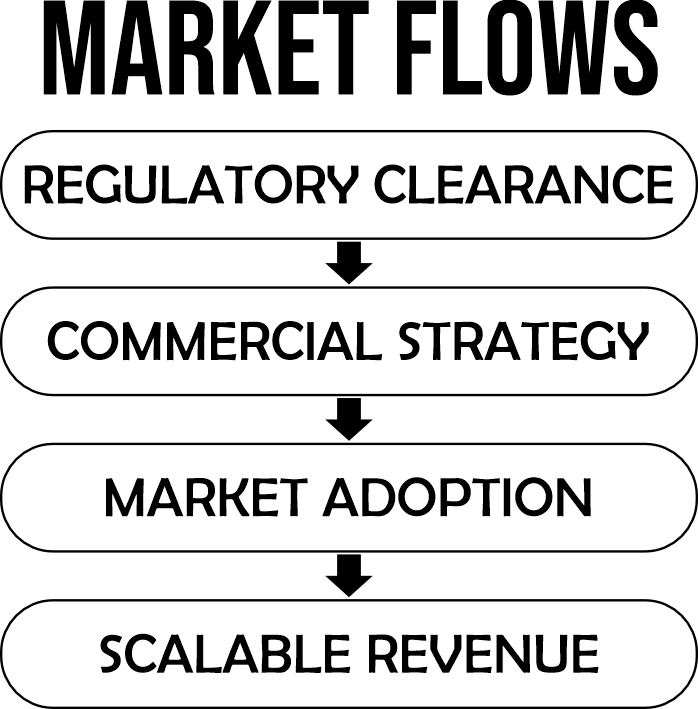
Commercial success follows a sequence—not just effort. Without a grounded strategy, every step that follows becomes harder to scale.
A weak strategy leads to:
Building the wrong type of clinical champion network
Choosing ineffective sales routes
Misallocating time, capital, and talent
A strong, realistic strategy does the opposite.
It brings clarity to:
Who actually buys
How they decide
What it takes to move from interest to adoption
And once that clarity exists, the other pillars become easier to build correctly.
What a Realistic Strategy Actually Looks Like
A strong commercialization strategy is not optimistic.
It is grounded.
It accounts for:
How long do hospitals really take to make decisions
What objections will likely arise
What level of support do clinicians need before adoption
How many interactions are required before a purchase happens
It also answers a critical question:
Do we have the resources to support this process fully?
Because in many cases, the investment required to build market traction is greater than expected.
The Shift That Changes Everything
The companies that scale successfully make a subtle but powerful shift.
They move from:
“We have a great product—sales should follow”
to:
“We understand exactly what it takes to convert interest into consistent revenue”
That shift changes how they plan, how they invest, and how they execute.
Build This First—or Pay for It Later
Commercialization doesn’t fail all at once.
It slows down quietly.
Timelines stretch.
Forecasts slip.
Teams push harder—but results don’t follow.
And by the time the problem becomes obvious, the cost of fixing it is already high.
The companies that scale successfully don’t wait for that moment.
They start with a strategy that reflects reality—not assumptions.
Because when your foundation is strong, everything that follows moves faster, with less friction, and far more predictability.


Comments